
Lyme Disease UK is thrilled to announce our first Innovation Award to fund pioneering Lyme diagnostics research. The project will take place at the flagship National Horizons Centre, within the School of Health & Life Sciences at Teesside University.
The work is led by PhD researcher Saba Niaz, supervised primarily by Dr Ojodomo Achadu, and co-supervised by Professor John Young.

The diagnostic challenge
Current Lyme disease diagnostics remain limited, often restricted to an imperfect two-tier antibody test. Test results can be slow and frustratingly insensitive, resulting in unnecessary investigations to look for alternative causes of symptoms.
Early diagnosis is critical to allow swift treatment which helps to prevent the debilitating, long-term complications associated with late-stage disease.
This innovative research aims to lead to the development of a rapid, sensitive, and portable point-of-care test to identify the infection directly. It does not rely on an antibody response.
Key features
The research aims to create a novel dual-modality biosensor for the direct detection of Borrelia bacteria. It uniquely combines fluorescence-based imaging and Raman spectroscopy on an origami paper platform.
- Raman spectroscopy: This advanced imaging technique analyses how light interacts with chemical bonds within a sample to identify the unique biochemical “fingerprint” of an infection.
- Dual-modality framework: Combining two distinct analytical models into a single framework helps to significantly reduce false-negative results.
- Origami (paperfolding) architecture: The multi-layered paper design (similar to a lateral flow test) filters and processes the sample as it moves through the folded paper.
- Bacterial strains: The test will first target Borrelia burgdorferi, then Borrelia afzelii and Borrelia garinii, covering the strains which most commonly cause disease in both the UK and Europe.
- Additional biomarkers: The platform will be expanded to detect additional biomarkers to help distinguish active infection from past exposure and Post-Treatment Lyme Disease (PTLD).
These features combine to offer an exciting new development in the world of Lyme disease diagnostics.
Future potential
- Adaptability: There is scope for the test to be further developed to detect additional strains and other pathogens. It could also potentially utilise different sample types.
- NHS: Engineered to eliminate long laboratory wait times, this point-of-care device could offer a low-cost, potentially attractive opportunity for the NHS.
- Timeline: This research is at an early laboratory development stage so a usable test is some years away. Lyme disease test development presents a notoriously difficult and expensive challenge, so it is important to manage expectations while remaining optimistic. Nevertheless, this foundational science is exciting and could one day lead to meaningful improvement for the Lyme disease community.
LDUK will continue to provide official updates as major milestones are reached.
International interest
In September, Saba has been offered the opportunity to present early-stage results on the international stage at the 2nd Annual Conference on Chronic Infection Pathologies (CIP) in Helsinki. She also previously presented at the ILADS conference in London earlier this year.
Technical information
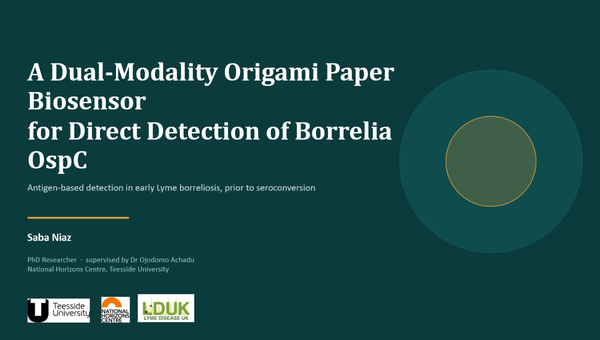
Click on the image below to view the technical presentation slides prepared for the CIP conference in Helsinki.
A special thank you to Team Seasoar
This research is made entirely possible through donations received by Team Seasoar, who rowed a gruelling 3,000 miles across the Atlantic Ocean in 2024/25 as part of the World’s Toughest Row to raise funds for Lyme disease research.
We are incredibly grateful to John Watling, Niall Brannigan, Sam Weber, and Jason Wilder for completing such an awe-inspiring challenge, and we deeply thank everyone who donated to support the team.
Revisit Team Seasoar’s arrival in Antigua as they complete the World’s Toughest Row Atlantic 2024.
